Intel and Google Cloud Push AI Agents Into Everyday Business Work
16 July 2026 · InstantStore AI team

Today’s top AI technology announcement
On Thursday, July 16, 2026, Intel and Google Cloud announced an expansion of their multi-year collaboration. The agreement will bring Gemini Enterprise to Intel’s global workforce and use Google Cloud infrastructure to support AI-powered workflows in engineering, supply chain, corporate operations and semiconductor development. ([publicnow.com](https://www.publicnow.com/view/50D4094F5BF3A00BCB9056CB0709A623B93C22F1?utm_source=openai))
The news is important because it shows where enterprise AI is heading next. Businesses are moving beyond experiments such as generating a product description or summarising a document. The new focus is on AI agents: systems that can understand a goal, work through multiple steps, use business software and help complete a process.
For a large chipmaker like Intel, that could mean agents assisting engineers, coordinating information across departments, improving development workflows and helping employees work faster. But the underlying lesson applies equally to a small online business in India.
From AI assistant to AI operator
Most sellers already understand the basic AI assistant. You type a request, receive an answer and then manually copy the result into your store, spreadsheet, social media account or customer-support process.
Agentic AI aims to reduce that manual handoff. An agent could potentially take a business objective such as “prepare this week’s campaign for cotton kurtas,” then help organise product information, draft several ad variations, suggest customer segments, prepare social posts and flag missing details for approval.
Google Cloud’s Gemini Enterprise platform is designed around this broader idea. Its capabilities include tools for building agents, coordinating longer-running tasks, connecting business systems and adding governance controls such as permissions, registries and monitoring. Google says its platform is intended to help organisations build, scale and manage agents rather than deploy isolated AI features. ([cloud.google.com](https://cloud.google.com/blog/products/ai-machine-learning/whats-new-in-gemini-enterprise?utm_source=openai))
The Intel announcement demonstrates that this approach is not limited to technology startups. It is being adopted inside complex businesses where accuracy, security and coordination matter.
Why Indian online sellers should care
For a seller in India, the immediate impact may not come from using Intel’s systems directly. The significance is that the tools and ideas developed for large enterprises are gradually becoming simpler, cheaper and more accessible to smaller businesses.
That could affect ecommerce in several practical ways.
Faster product publishing: AI agents can help turn a basic catalogue entry into a complete product page with titles, descriptions, specifications, FAQs and marketing copy. Sellers may be able to publish more products without writing every listing manually.
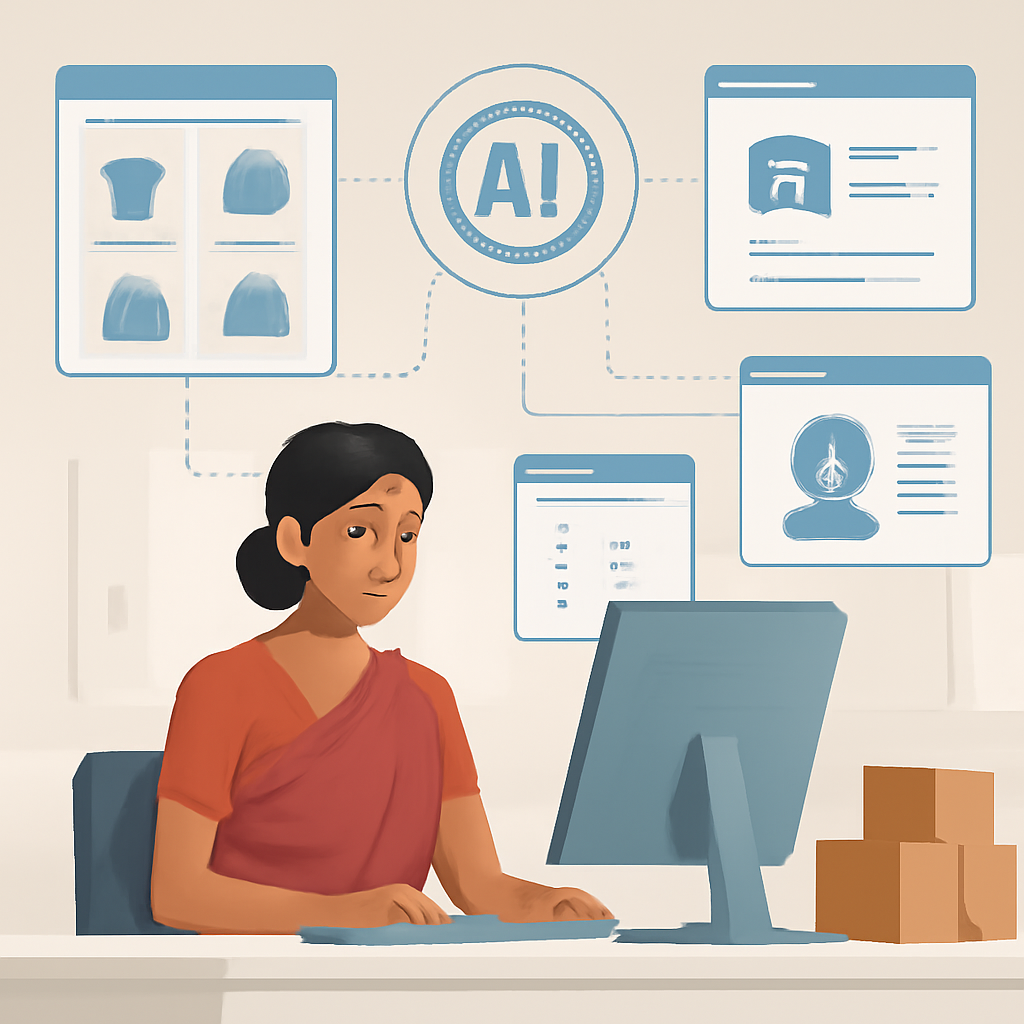
Better regional marketing: India’s ecommerce market is multilingual and highly local. AI can help adapt a campaign for English, Hindi and regional-language audiences, while also adjusting tone for marketplaces, WhatsApp, Instagram and a storefront.
Quicker customer support: An agent can classify common questions about delivery, sizing, returns and payments, then suggest or send approved responses. Human attention can remain focused on unusual or sensitive cases.
Smarter inventory decisions: When connected to sales and stock data, AI may help identify fast-moving products, slow-moving variants and replenishment priorities. This matters especially for small sellers who cannot afford to lock cash into excess inventory.
More consistent campaigns: Instead of creating one-off posts whenever there is time, sellers could use repeatable workflows for weekly promotions, festival sales, abandoned-cart messages and new-product launches.
The important caution: automation needs supervision
The promise of AI agents is attractive, but small businesses should not hand over every decision immediately. An agent can misunderstand a discount, describe a product inaccurately or make an inappropriate promise about delivery. In India, where customer expectations, languages and payment preferences vary widely, human review remains essential.
Start with low-risk, repeatable tasks. Let AI draft listings, organise ideas or prepare replies, but require approval before it changes prices, issues refunds, contacts customers or launches paid advertising. Keep a record of what the system changed and give each tool access only to the information it needs.
This emphasis on controlled workflows is one of the most important parts of the Intel-Google announcement. Enterprise AI is not only about model intelligence; it is also about permissions, monitoring and accountability. Google’s Gemini Enterprise updates highlight identity, agent registries, gateways and observability as ways to govern AI activity. ([cloud.google.com](https://cloud.google.com/blog/products/ai-machine-learning/whats-new-in-gemini-enterprise?utm_source=openai))
What sellers can do today
Small sellers do not need to build a complex AI platform to benefit from this trend. Begin by listing repetitive tasks that consume time each week: writing descriptions, answering routine questions, resizing images, planning campaigns or checking stock.
Next, create simple approval-based processes. For example, prepare a product-information template, define your brand voice and specify claims that AI must never make without verification. The clearer your business data and rules are, the more useful future AI tools will become.
Platforms such as InstantStore AI fit naturally into this transition by helping Indian sellers create and manage an online storefront without needing a large technical team. The long-term opportunity is not merely to add a chatbot to a store, but to build practical AI-assisted workflows around products, customers and orders.
The Intel and Google Cloud announcement is therefore more than a partnership story between two global technology companies. It is a signal that AI is becoming part of the operating layer of business. For Indian online sellers, the competitive advantage may go to those who learn early how to combine automation with strong product data, local market understanding and human trust.